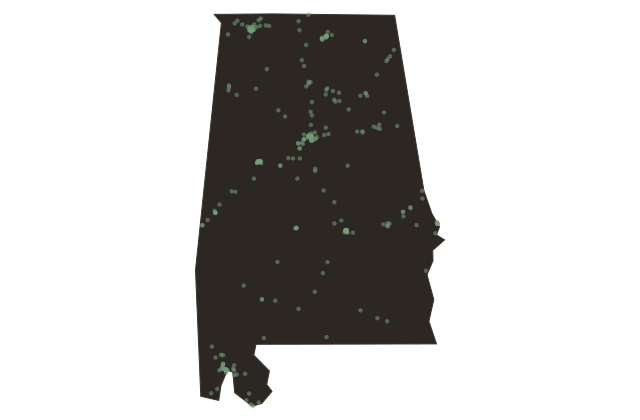
Epes, Alabama
Alabama
The bluff on which Epes sits was once the site of Fort Tombecbe, built in seventeen thirty-six by French troops, with construction taken over by Jean-Baptiste Le Moyne de Bienville. The fort was France's western anchor in the lower South, a trading post and military outpost meant to cement the French alliance with the Choctaw nation and hold off British expansion from the Carolina coast.
The fort was eventually abandoned as colonial powers shuffled this territory back and forth. France ceded the fort to Britain in seventeen sixty-three, and the British renamed it Fort York before abandoning it after a truce in seventeen sixty-eight. The Choctaw later ceded the land to Spain, which built Fort Confederacion, and under the Treaty of San Lorenzo the site passed to the United States. By the nineteenth century the bluff served as a cotton shipping point, with steamboats calling at the Port of Epes. The town that grew there took its name not from any French legacy but from John W. Epes, a physician who sold land to the Great Southern Railroad around eighteen seventy for a depot. Epes Station was incorporated in eighteen ninety-nine. The French fort is gone, but a historical marker on the bluff notes that the deep colonial history of this small Sumter County town long predates the railroad.
In its prime Epes was a transportation and business center, with cotton gins, a cotton compress, stores, and hotels, and a stockyard opened there in nineteen thirty-six. Only about two hundred seventy-two people lived there at the twenty twenty census.