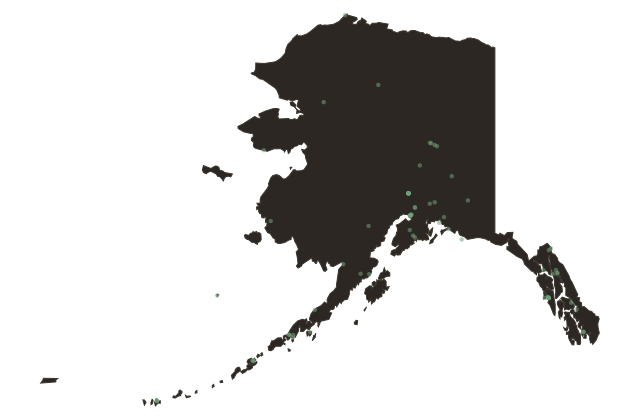
The Bush: Two Hundred Communities at the End of No Road
Alaska
The word the state uses is straightforward: Bush. No road. No connection to the highway grid. No way in or out except by small plane, river craft, or when the season allows it, snowmachine across the frozen tundra.
More than two hundred Alaska communities live this way, and they have for far longer than there were any roads to lack. The Yup'ik villages of the Yukon-Kuskokwim Delta, where the Yukon and Kuskokwim rivers empty into the Bering Sea across a flood plain about the size of Louisiana, are among the most remote permanent communities in the United States. Bethel is the regional hub, reachable by plane or, in some seasons, by river barge. The fifty-plus villages around it are reachable, in most cases, only by small aircraft.
The economics of Bush life are striking. A gallon of heating fuel in a western Alaska village can cost eight to ten dollars when the same gallon costs two in Anchorage. A bag of flour that costs three dollars in a Fairbanks grocery store costs twelve or fifteen in a village. Medical emergencies require medevac flights. Education beyond the village level requires boarding schools in larger hubs.
And yet these communities persist because they are not simply remote outposts waiting for roads. They are the continuation of cultures that have been in these river drainages, these coastal zones, and these Interior valleys for thousands of years. The Yup'ik language is still spoken as a first language in many of the Kuskokwim villages. Gwich'in is spoken in Arctic Village and Venetie. Central Siberian Yupik is spoken on Saint Lawrence Island. These are not dying languages. They are living languages in communities that chose where they are and have not been convinced to leave.
The Bush is not a failure of infrastructure. It is a different relationship to geography than the lower forty-eight states have ever managed to imagine.