The Unangax̂ and the Edge of the Pacific World
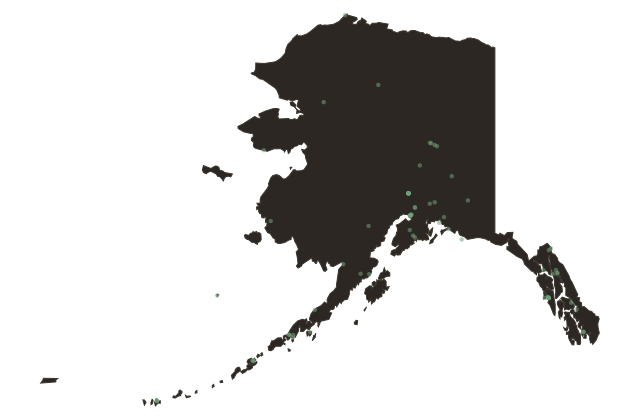
Alaska
The Aleutian Islands form one of the longest island arcs on Earth, a volcanic chain that stretches twelve hundred miles from the Alaska Peninsula to within two hundred miles of Russia's Kamchatka Peninsula. The Unangax̂, whom English speakers have historically called Aleuts, have occupied these islands for at least nine thousand years, and possibly as many as ten thousand, making them among the longest continuously resident human populations in the Americas.
They arrived in the islands during a period when the Bering Land Bridge was still above water, moving east along the coast. Over thousands of years, they developed technologies precisely calibrated to an environment that offers no trees, little soil, frequent storms, and extraordinary marine abundance. The baidarka, their kayak, was arguably the most hydrodynamically sophisticated watercraft constructed by any preindustrial culture. Early European explorers who encountered the Unangax̂ in their baidarka described men who could paddle sixty miles in a day and who could navigate fog and ocean swell by feel, by sound, and by the behavior of birds.
At the time of European contact in the seventeen forties, the Unangax̂ population across the Aleutian chain has been estimated at between twelve thousand and twenty-five thousand people. A century after sustained Russian contact began, the population had fallen to somewhere between two thousand and four thousand. The causes were disease, introduced by Russian and European traders; direct violence during early Russian encounters, particularly the massacres carried out by the promyshlenniki, the freelance fur traders who preceded the Russian-American Company; and the coercive labor system the Company later institutionalized.
The Unangax̂ survived all of this, and the Russian internment of World War Two, and the dispersal of their communities, and the commercial hunting that took the sea otters their culture was built around. They are still in the islands, speaking Unangam Tunuu in communities where the language has been maintained, and teaching their children what their grandparents remembered.