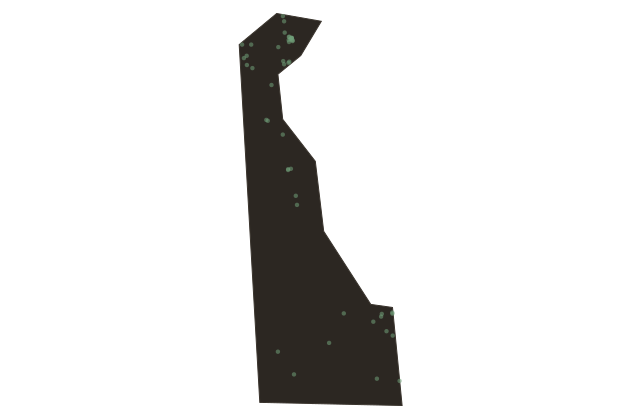
The First State, December Seventh, Seventeen Eighty-Seven
Delaware
On the seventh of December, seventeen eighty-seven, thirty delegates gathered at the Golden Fleece Tavern in the town of Dover and voted unanimously to ratify the United States Constitution. Delaware did it in less than five days of deliberation, making it the first of the original thirteen colonies to approve the document, and earning the nickname that has adorned its license plates ever since: The First State.
The speed was not accidental. Delaware was the smallest state by area, sandwiched between the much larger Pennsylvania and Maryland, with a population that gave it only one seat in the House of Representatives. Under the Articles of Confederation, which apportioned votes equally by state, Delaware had the same voice as Virginia. Under the new Constitution's proposed Senate, with two senators per state regardless of population, Delaware would retain that parity. The small state had everything to gain from ratification and little to lose. Its delegates were also well-organized: John Dickinson, one of the most experienced constitutional lawyers in America, had shaped the very arguments Delaware's ratifiers were now adopting.
The unanimous vote mattered beyond Delaware. It gave the new Constitution its first momentum at a moment of genuine uncertainty. No one knew whether the larger and more fractious states, New York, Virginia, Massachusetts, would follow. Having one clean ratification on record, however small the state, signaled that the document could actually win. Delaware's alacrity did not merely make it first. It helped make ratification possible.
Today the document that Delaware's delegates signed is preserved in Dover. The Golden Fleece Tavern where they gathered no longer stands, but Dover's Old State House still does.