Bonar Hall: Cotton Money, Thick Walls, and a Half-Sister's War
Georgia
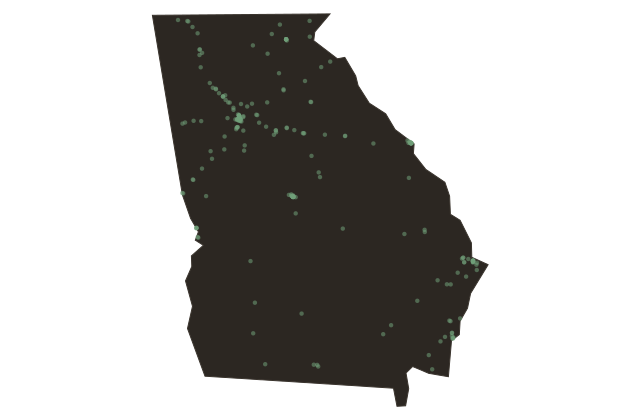
The two-story brick house on Dixie Avenue in Madison is one of the earliest and finest expressions of the cotton-boom prosperity that transformed middle Georgia in the decades before the Civil War. Bonar Hall was begun in eighteen thirty-nine by John Byne Walker, one of Morgan County's wealthiest planters, and his wife Eliza Fannin. Its walls are eighteen inches thick. Its ceilings rise thirteen feet. Its doorknobs were silver.
The connection Walker married into carried its own remarkable history. Eliza Fannin was the half-sister of James Fannin, the commander at Goliad during the Texas Revolution, whose execution along with nearly four hundred of his men by Mexican forces in eighteen thirty-six became one of the galvanizing atrocities of that conflict. The cry Remember Goliad was still raw when the first bricks were laid at Bonar Hall.
The house anchors Madison's historic district, which survived the Civil War largely intact. General Sherman's army marched through middle Georgia in late eighteen sixty-four, and most towns in its path were burned. Madison was spared because it was the home of Joshua Hill, a pro-Union former United States senator who had opposed secession and maintained contacts with Northern leaders. The town Sherman refused to burn, the saying goes, still carries more than one hundred antebellum structures.
Bonar Hall served as a makeshift hospital after the Battle of Chickamauga in eighteen sixty-three, when the Confederate casualties overwhelmed the medical facilities further south. The house was purchased in nineteen twenty by Josie Bacon, a relative of Eliza Fannin, who gave it the name it carries today: Bonar, after one of her own ancestors.
It has been on the National Register of Historic Places since nineteen seventy-two. It remains privately owned and, from the outside at least, looks much as it did when Walker's enslaved workers finished the brickwork in the summer of eighteen thirty-nine.