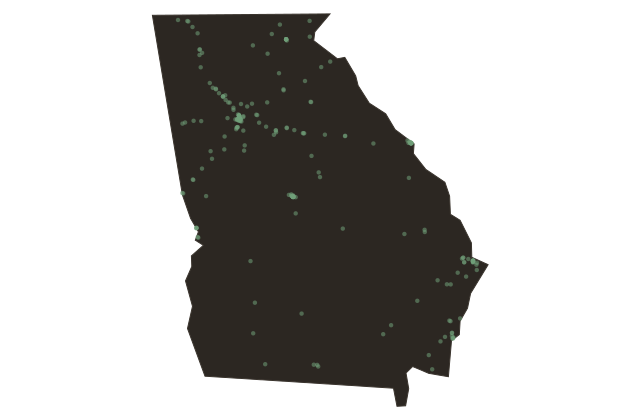
Druid Hills Historic District, Atlanta
Georgia
The broad, parkway-lined streets of Druid Hills are one of the finest surviving examples of American suburban landscape design, and they exist because of two men's ambitions that collided and eventually converged. The first was Joel Hurt, an Atlanta entrepreneur who in the early eighteen nineties assembled a large tract of land east of downtown and hired Frederick Law Olmsted to plan his ideal residential suburb. The second was Asa Candler, the president of the Coca-Cola Company, who bought Hurt's development company in nineteen oh eight and completed what Olmsted had conceived.
Olmsted, who had already designed Central Park in New York and the grounds of the United States Capitol, created his eighteen ninety-three plan for Druid Hills around Ponce de Leon Avenue, a broad parkway divided by a chain of linked parks running nearly two miles. The parks were not afterthoughts: they were the organizing spine of the neighborhood, naturalistic green spaces that gave each residential block its relationship to landscape rather than simply to the street grid. Druid Hills became the last major residential design project of Olmsted's career, and the only subdivision in which Olmsted Senior and both of his sons, working as the Olmsted Brothers firm, were all involved.
Work began in earnest in nineteen oh five. By the time Atlanta's streetcar network connected Druid Hills to downtown, the neighborhood filled with the prosperous families of a New South city: doctors, lawyers, merchants, and the executives of an industrializing Atlanta. The houses range from Colonial Revival and Tudor styles to Craftsman bungalows, stitched together by the canopy of oaks and the Olmsted parks.
In nineteen seventy-five, a proposed freeway threatened to cut through the neighborhood. The resistance that arose led to the nomination of Druid Hills to the National Register of Historic Places, and in nineteen seventy-nine the full thirteen-hundred-acre historic district received that designation. The freeway was never built.
Druid Hills also has an unexpected Hollywood connection: the neighborhood's homes and parks served as the filming location for Driving Miss Daisy, the nineteen eighty-nine film set in Atlanta's mid-century Jewish community. The landscape on screen is the landscape outside your window.