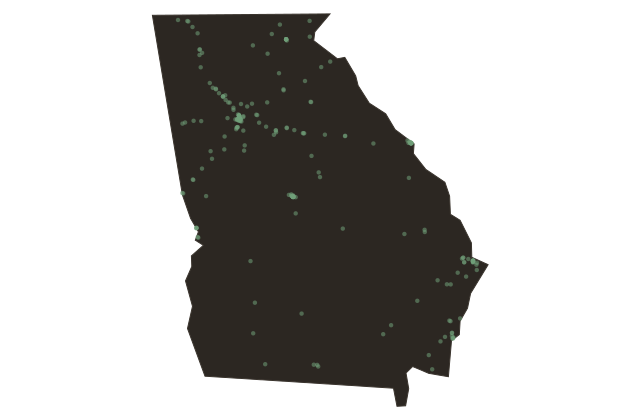
The Civil Rights Movement at State Scale
Georgia
The civil rights movement was not a single event in Georgia. It was a decades-long, statewide campaign conducted by thousands of people most of whose names never appeared in a newspaper headline.
It began, in one sense, with the formation of the Georgia Equal Rights League after World War One, and with the long organizing work of educators, ministers, and farmers who built the institutional infrastructure that later movements would use. It ran through the founding of the Southern Christian Leadership Conference in Atlanta in January nineteen fifty-seven, the meeting at Ebenezer Baptist Church where a then twenty-seven-year-old Martin Luther King Junior became the organization's first president.
But the movement stretched far beyond Atlanta and far beyond King. In Albany in nineteen sixty-one and nineteen sixty-two, the Albany Movement brought together Student Nonviolent Coordinating Committee organizers including a young Cordell Reagon and Bernice Johnson, later Bernice Johnson Reagon, who would go on to found Sweet Honey in the Rock. The Albany campaign was a tactical setback, Police Chief Laurie Pritchett studied nonviolent theory and countered it by refusing to allow the beatings that drew national press coverage, but it was also a training ground that shaped the later campaigns in Birmingham and Selma.
In Americus, in southwest Georgia, SNCC workers faced some of the most violent resistance in the state. In Terrell County, Prathia Hall preached freedom sermons so vivid that a young minister from Atlanta named Martin King heard her use the phrase I have a dream and later made it his own. The full story of Georgia's civil rights movement runs from the coast to the mountains and belongs to thousands of people, most of them ordinary women and men who simply refused to accept what they were told was permanent.