The Living Land, Volcanoes and How Hawaii Is Made
Hawaii
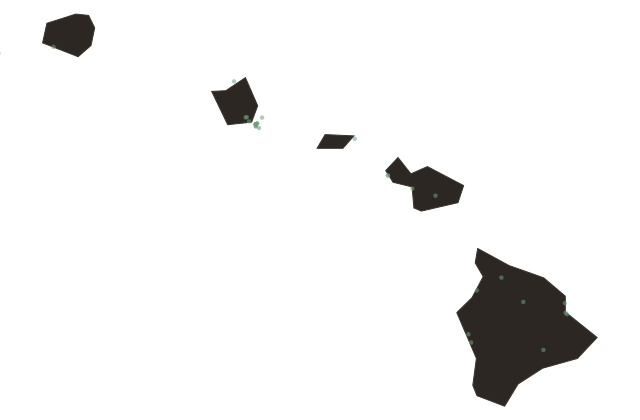
The Hawaiian Islands do not simply sit in the ocean. They are produced by it, pushed up from below by a fixed column of superheated rock called a hot spot, a plume in the Earth's mantle that has been burning through the Pacific Plate for at least eighty million years. The plate moves northwest at roughly three and a half inches per year. The hot spot stays put. The result is a chain of islands that grows progressively older as you travel northwest, from the actively erupting volcanoes of the Big Island to the ancient, eroded peaks of Kauai, to the coral atolls of the Northwestern Hawaiian Islands, to the seamounts that have sunk entirely back into the sea.
Hawaii Island at the southeastern end of the chain is the youngest. Its two great volcanoes, Mauna Kea and Mauna Loa, are shield volcanoes, broad and gently sloping, built by layer after layer of low-viscosity basaltic lava rather than the explosive pyroclastic eruptions of continental volcanoes. Kilauea, on the island's southeastern flank, erupted nearly continuously from nineteen eighty-three until twenty eighteen, and has erupted again in episodes since. In Hawaiian tradition, Kilauea is the home of Pele, the volcano goddess. The distinction between the geological fact and the spiritual one is not always as sharp as Western categories suggest.
There is also a sixth Hawaiian island that does not yet exist. Loihi, a seamount off the southeastern coast of Hawaii Island, is actively erupting below the surface of the ocean. It is expected to break the surface in many thousands of years, possibly as many as two hundred thousand. The hot spot that made all of these islands is already building the next one. The archipelago is not finished.
What this means for anyone driving through Hawaii is that the ground beneath every road, every farm, every city on these islands was once liquid rock. The land is new by geological standards, endlessly renewing, and the relationship between the Hawaiian people and that land, the spiritual and genealogical ties encoded in the names of every lava field and every wind, is a relationship with a living thing.