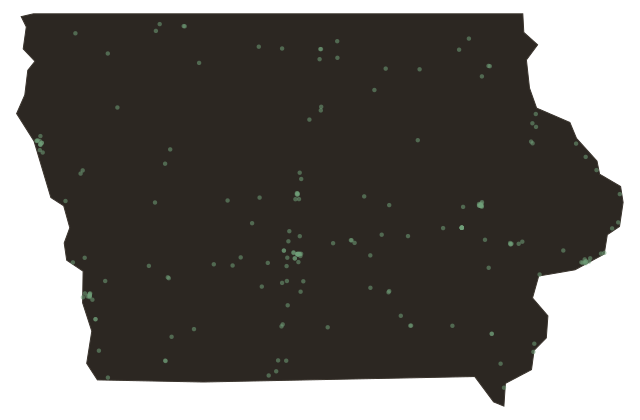
Corn, Hogs, and the Architecture of Agribusiness
Iowa
Iowa leads the nation in corn production most years, and has for most of the last century. It also leads in hog production, processing more pork than any other state by a wide margin. Those two facts are connected. The corn feeds the hogs. The hogs convert it into protein that can be sold at higher margins than grain. The relationship is so deeply embedded in Iowa's economy that it has shaped the physical landscape: the confinement buildings, the grain elevators, the ethanol plants, the packing plants sitting just outside small cities.
But the system you see today is not the one that existed a generation ago. The family farm of the mid-twentieth century, a few hundred acres, a mixed operation with hogs, cattle, chickens, and crops, has largely given way to large-scale specialized operations. Hog confinement buildings that house thousands of animals have replaced the small pasture herd. Contract farming, where a family provides the labor and land while a corporation owns the animals, has become the dominant model in pork production. Iowa has more than twenty-two million hogs on any given day. That is roughly seven pigs for every human resident.
The consolidation happened fast. In the nineteen seventies, most Iowa hog farms were small operations. By the early two thousands, the top four pork processors controlled the majority of the market. The farms got bigger, the towns got smaller, and the employment that once supported rural Main Streets shifted toward a smaller number of large plants. This is not Iowa's fault, and it is not unique to Iowa. It is the shape that American agriculture took when capital discovered that efficiency in food production looks a lot like efficiency everywhere else. The question Iowa wrestles with now is what to do with the landscape, the groundwater, and the communities that this system leaves behind.