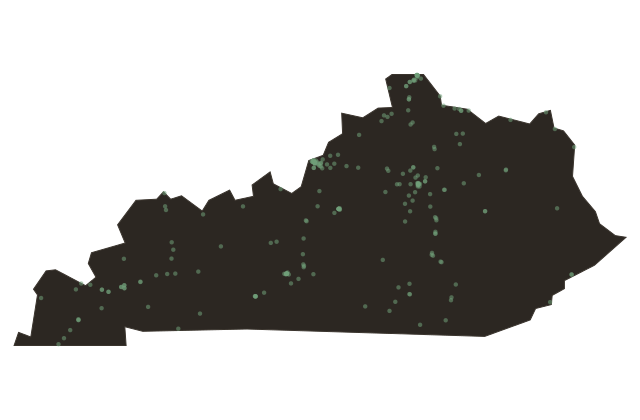
Bloody Monday, 1855
Near Louisville, Kentucky
Election day in Louisville on August sixth, eighteen fifty-five fell in the middle of a summer already hot with nativist politics. The American Party, known as the Know-Nothings, had been running candidates across the country on a platform of Protestant nativism, warning that Catholic immigrants from Ireland and Germany were a threat to American democracy. In Louisville, where Irish and German newcomers had come to make up roughly a third of the city's population, the rhetoric had been particularly inflamed by George D. Prentice, the editor of the Louisville Journal, whose anti-Catholic editorials had run for months.
On election day, organized Protestant mobs moved through the city's Irish and German Catholic neighborhoods. They attacked voters at polling places, preventing immigrants from casting ballots. The violence escalated through the day into the evening. Buildings were set on fire. Street fighting broke out across multiple neighborhoods.
When it was over, twenty-two people were dead, scores were wounded, and property damage was extensive. The attack became known as Bloody Monday.
Five people were eventually indicted. None were convicted.
The immediate consequences extended beyond the dead and injured. More than ten thousand Louisville residents, most of them from the German and Irish communities, packed up and left the city in the months that followed. They went to St. Louis, to Chicago, to Milwaukee, to cities where the nativist rage had not yet found the same organized expression. A substantial group emigrated to Kansas in eighteen fifty-six.
The German community that rebuilt in Louisville became, in the following decades, one of the most economically significant in the city's history. Several of the bourbon distilling dynasties, the families whose names appear today on bottles shipped around the world, were German immigrants who arrived in the years just after Bloody Monday and stayed.