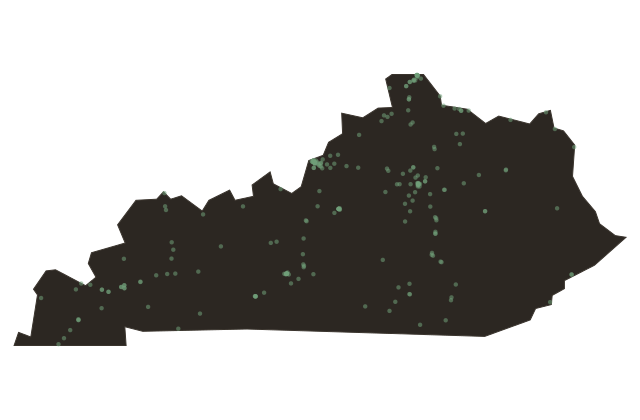
Corner in Celebrities: Frankfort's River Street of Notables
Kentucky
In the northern section of Frankfort, just above the bend of the Kentucky River, sits one of the more peculiarly named historic districts in America: the Corner in Celebrities. The name is not ironic. This concentrated cluster of early Federal and Greek Revival houses genuinely was home, at various points, to some of the most consequential figures in Kentucky and American political history.
The district centers on Wapping Street, a narrow thoroughfare that borrowed its name from the old Wapping Stairs along the Thames in London, a reminder of how closely Kentucky's early elite tied their self-image to English precedent. The buildings date from roughly eighteen hundred onward, and their architecture spans Federal, Georgian, and Greek Revival modes, a clean record of how American domestic taste shifted through the first half of the nineteenth century.
Among the notable figures associated with homes in this district: George M. Bibb, who served as a United States Senator from Kentucky and later as Secretary of the Treasury under President John Tyler; Thomas Todd, who sat on the United States Supreme Court from eighteen oh seven to eighteen twenty-six; and John J. Crittenden, one of the most influential Kentucky politicians of the antebellum era, whose sons would fight on opposite sides of the Civil War. The Crittenden-Garrard House in the district was owned in turn by Thomas Crittenden, a Union major general, and later by James H. Garrard, grandson of Kentucky's second governor.
Frankfort became Kentucky's permanent capital in seventeen ninety-two, and the Corner in Celebrities reflects the gravitational pull that a state capital exerts on ambitious men who want to be close to power. Judges, senators, governors, and their associates built their private homes within walking distance of the statehouse, clustering on these river-facing streets where a neighbor in one direction might be a sitting Supreme Court justice and a neighbor in the other a future cabinet secretary.
The district was added to the National Register of Historic Places in nineteen seventy-one.