The Scandinavians: How the North Woods Became New Norway and New Sweden
Minnesota
Ole Rølvaag, who grew up in Norway and emigrated to South Dakota before settling in Northfield, Minnesota, where he taught at Saint Olaf College for thirty years, wrote in his nineteen twenty-seven novel Giants in the Earth that the prairie broke people as surely as it built them. He knew this from listening to his own family and neighbors. The immigrant experience in the upper Midwest was not uniformly triumphant. It was also very cold, and very lonely, and sometimes psychologically devastating.
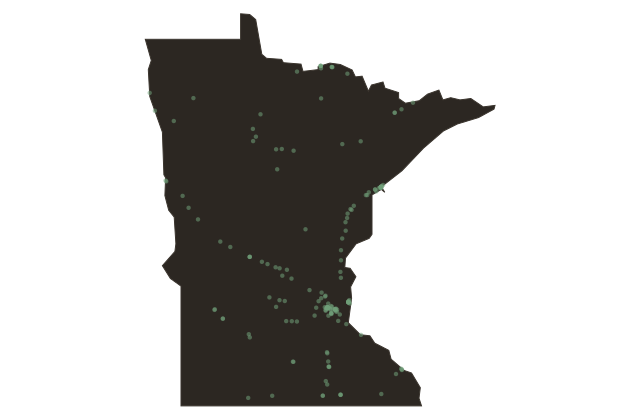
But they came anyway, and they kept coming. Between roughly eighteen sixty and nineteen fifteen, Minnesota received one of the largest proportional flows of Scandinavian immigration anywhere outside Scandinavia itself. Norwegians settled the southeastern valleys, the western prairie counties, and the northern cutover. Swedes concentrated in Chisago County north of St. Paul, in Minneapolis, and along the St. Croix Valley. Finns came last and densest, drawn to the Iron Range in the eighteen nineties by the same mining boom that needed workers, settling in towns like Ely and Virginia and Hibbing alongside Croatian and Italian and Slovenian immigrants from southern Europe.
The Scandinavian immigrants brought with them Lutheran and Baptist churches, cooperative economic principles that would later flower in the Farmer-Labor political tradition, and a set of practical skills, carpentry, fishing, forest management, that fitted the northern Minnesota landscape almost perfectly. They also brought their foods, their languages, their newspapers, and their names.
In eighteen eighty, the population of Minnesota was roughly seven hundred eighty thousand. By nineteen ten, it was over two million. The state grew tenfold in a generation, and much of that growth was Scandinavian and German immigration settling the agricultural south and west and the industrial north. Counties in the Red River Valley today still have higher concentrations of Norwegian ancestry than anywhere outside Norway. The Lutheran churches, the cooperative grain elevators, and the cultural assumption that community institutions should be run for the benefit of members rather than shareholders, all of these are inheritances of the Scandinavian immigration era, and they are still visible in how Minnesota thinks about itself.