Humboldt-Toiyabe: Six Million Acres of Invisible Nevada
Nevada
Nevada is one of the most mountainous states in the lower forty-eight. That is not a fact that most people carry with them. The Basin and Range province that defines the state's geography is a series of north-south mountain ranges separated by flat desert valleys, and from the interstate, which runs along the valley floors, you mostly see the flats. The mountains are always there on the horizon, but they recede as you approach because the next valley and the next range open up ahead. You cross Nevada and wonder where the state went.
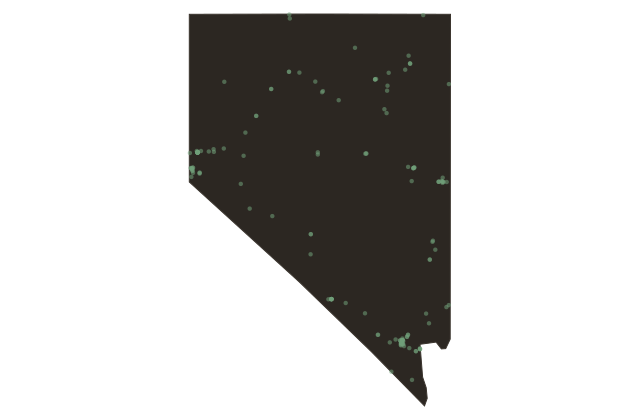
Humboldt-Toiyabe National Forest is what lives in those mountains. At six million three hundred thousand acres, it is the largest national forest in the continental United States. It is scattered across roughly half of Nevada and a portion of eastern California in units so numerous and so separated by private and public land that no single drive takes you through it. The Ruby Mountains unit in northeastern Nevada, sometimes called the Alps of Nevada, rises to more than eleven thousand feet. The Spring Mountains unit northwest of Las Vegas, often administered separately as Spring Mountains National Recreation Area, climbs to eleven thousand nine hundred and sixteen feet at Charleston Peak.
The forest takes its name from a river and a mountain range. The Humboldt River, which crosses northern Nevada and was the highway of the emigrant trails, was named for the Prussian naturalist Alexander von Humboldt, who never visited Nevada. The Toiyabe Range in central Nevada gave its name to the southern portion. The combined designation is an administrative artifact of consolidations and rationalizations over a century of federal land management, not a single coherent landscape.
What it is, in aggregate, is the ecological backbone of Nevada: the high-elevation terrain where water falls as snow, collects in basins, and either percolates into the groundwater that feeds the valley-floor agriculture or runs off into the ephemeral streams that define the desert hydrology. Without the mountains, there is no Nevada that can be inhabited at scale. The mountains are the forest. The forest is where the water comes from.