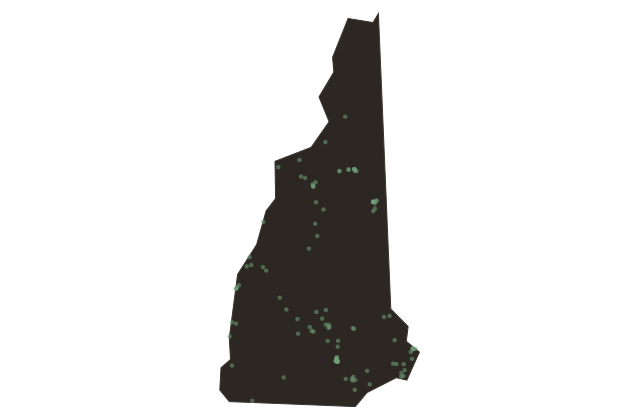
Rochester, New Hampshire: Three Rivers, One City
New Hampshire
Rochester sits where three rivers meet, and for two centuries those rivers made it what it became.
The Cocheco, the Salmon Falls, and the Isinglass rivers converge in this corner of Strafford County, and by the early eighteen hundreds their current was too useful to ignore. In eighteen eleven the first major industrial operation appeared: the Gonic Woolen Mills on the Cocheco, producing flannel for the workers and farmers of New England. Tanneries and sawmills followed, using the waterways both for power and for transport.
Rochester was first settled in the seventeen twenties and incorporated as a town in seventeen twenty-two, among the older communities in New Hampshire. Its early economy ran on timber, farming the river bottoms, and small-scale trade. The town supplied masts for the King's Navy from the Whitehall Swamp, those tall white pines considered the exclusive property of the Crown before the Revolution. When that arrangement ended, Rochester found new industry.
Shoe manufacturing transformed the city in the second half of the nineteenth century. It began in eighteen forty-three with small neighborhood workshops, craftsmen working in the back rooms of their houses and sending finished shoes to markets in Boston. By eighteen eighty, mechanized shoe factories had surpassed textiles as Rochester's dominant industry. The Wallace Shoe Company alone eventually occupied five acres on South Main Street, and Rochester became one of the major shoe-producing cities in New Hampshire.
The demands of the Civil War accelerated everything. Cocheco Manufacturing, founded in East Rochester in eighteen sixty-three, made woolen blankets for Union soldiers. Shoe shops supplied boots to an Army that consumed them at a prodigious rate. The city that emerged from the war was a manufacturing center of regional importance.
Rochester incorporated as a city in eighteen ninety-one. Today its old mill buildings mark the riverside neighborhoods where the waterpower economy once ran at full speed.