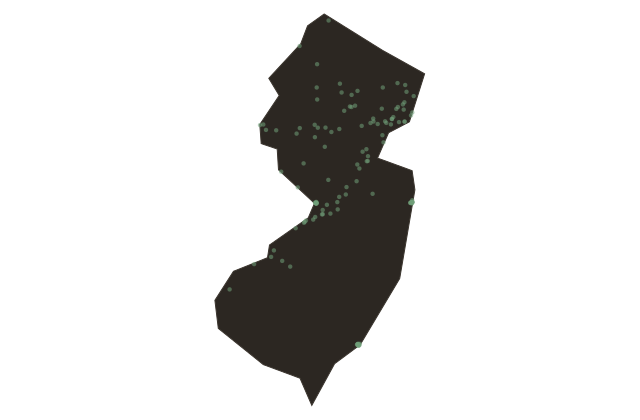
Between Two Cities, The New Jersey Paradox
New Jersey
New Jersey is the most densely populated state in the country. More than nine million people in less than eight thousand eight hundred square miles, that is well over one thousand people per square mile. And yet it has no dominant city of its own.
It is defined, in the popular imagination and in its own self-understanding, by its position between two cities that belong to other states. New York pulls from the north and east. Philadelphia pulls from the south and west.
The New Jersey Turnpike and the Garden State Parkway and the commuter rail lines are the arteries of a state that has largely organized its economy around getting people to and from places that are not New Jersey. Newark Liberty International Airport serves tens of millions of travelers who think of themselves as going to or from New York. The Port of New Jersey and New York handles more container cargo than any port complex on the East Coast, but the name of the state comes second.
And yet something particular did take shape here. The suburb, as an American institution, the single-family house on a quarter-acre lot within train-commuting distance of a great city, was pioneered in New Jersey in the late eighteen hundreds. Llewellyn Park in West Orange, developed in eighteen fifty-seven, is often cited as the first planned suburban community in the United States.
The parkway-and-cul-de-sac geography of post-war New Jersey became the template that built the American middle-class landscape across the entire country. New Jersey also has Newark, Paterson, Camden, Trenton, and Elizabeth: old industrial cities that have struggled with the same forces of deindustrialization and disinvestment that hit Pittsburgh and Detroit and Cleveland. The state is a live argument between its Garden State mythology and its industrial reality, between the Shore and the Turnpike, between the suburb and the city.
It has never fully resolved that argument, which is perhaps why it is so interesting.