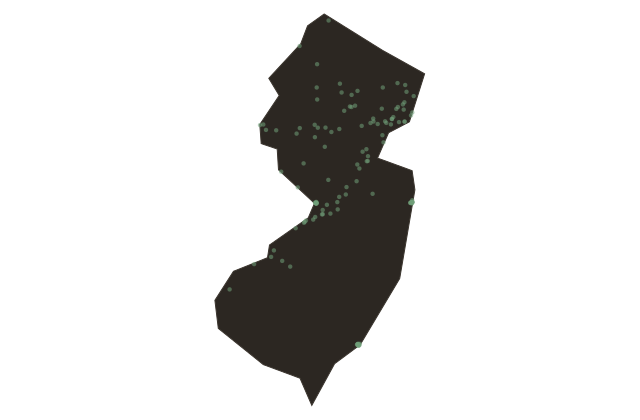
Jersey City: America's Most Contested Shore
New Jersey
You are approaching Jersey City, and what you are approaching is not just a city but a shoreline that has been continuously contested for nearly four centuries, beginning with the Dutch merchant Michiel Reyniersz Pauw, who in sixteen thirty received a patroonship grant covering this bank of the Hudson River from the Dutch West India Company, a territory that took his Latinized name, Pavonia.
The Lenape had used these river banks and meadows for thousands of years before European contact. Dutch and English settlement here was slow and violent, interrupted by the Peach Tree War of sixteen fifty-five, in which Lenape warriors retaliated for European encroachments with coordinated raids across the region. By the time the British consolidated control of the Hudson Valley in the sixteen sixties, a recognizable European settlement pattern had taken hold along the Jersey side of the river.
What transformed the area was industry and the railroad. By the mid-nineteenth century Jersey City had become the terminal point for nearly every major railroad entering from the west and south: the Pennsylvania Railroad, the Erie, the Central Railroad of New Jersey. Passengers and freight arriving from the continent had to cross the Hudson by ferry to reach Manhattan. Jersey City was the loading dock for a continent.
That geography made it a magnet for immigrants. Irish, German, Italian, Polish, and African American communities layered onto each other through the nineteenth and twentieth centuries, shaped and reshaped by the waterfront economy. The political machine of Frank Hague, who controlled Jersey City from nineteen seventeen to nineteen forty-seven as one of the most powerful and autocratic Democratic bosses in American history, organized much of this immigrant energy into raw political force.
Today Jersey City is the second-largest city in New Jersey and one of the most demographically diverse cities in the United States, a skyline of towers rising directly across the river from Lower Manhattan.