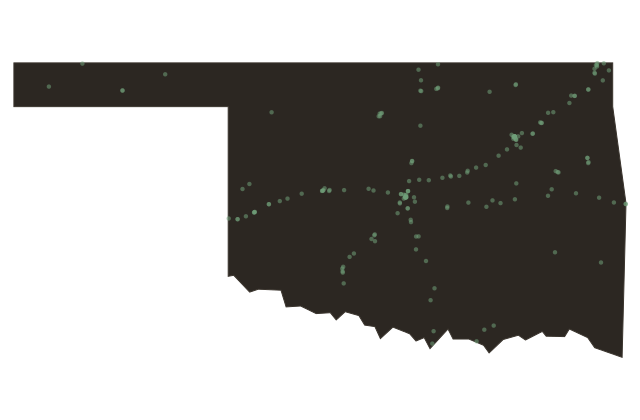
The Map That Was Promised
Oklahoma
Before Oklahoma was a state, before it was a territory, it was the place the United States put everyone it had decided to move. Starting in the eighteen thirties and continuing for decades, the federal government relocated dozens of tribal nations from their homelands in the East and the Southeast and sent them west, across the Mississippi, to a stretch of grassland and Cross Timbers scrub that federal negotiators called permanent Indian Territory.
The Five Civilized Tribes arrived first: the Choctaw walking through Mississippi winter, the Cherokee on what would become known as the Trail of Tears, the Creek and Chickasaw and Seminole under duress and at gunpoint, each nation carrying its laws, its churches, its newspapers, its memory of a homeland they would not see again. But they were not alone. By the middle of the nineteenth century, more than thirty tribal nations had been moved into what is now Oklahoma, including the Shawnee, the Potawatomi, the Delaware, the Kickapoo, the Sac and Fox, the Cheyenne, the Arapaho, and the Comanche. Nations that had never lived as neighbors, that spoke entirely different languages, were now separated from one another by treaty lines drawn in Washington.
What those treaties promised, in many cases, was permanence. Indian Territory would be theirs, the documents said, for as long as the rivers ran. The promise lasted roughly a generation. By the eighteen eighties, white settlers were pressing against every boundary. By nineteen hundred and six, the allotment era had broken the communal land base into individual parcels, and the federal government was already planning to extinguish the territorial governments entirely. What had been promised as a permanent homeland became the floor of a new American state.
The land is still here. So are the nations. Thirty-nine federally recognized tribes call Oklahoma home today, one of the largest concentrations of any state, and their governments, schools, hospitals, and cultural institutions remain active across the entire geography of this place. The map changed. The people did not leave.