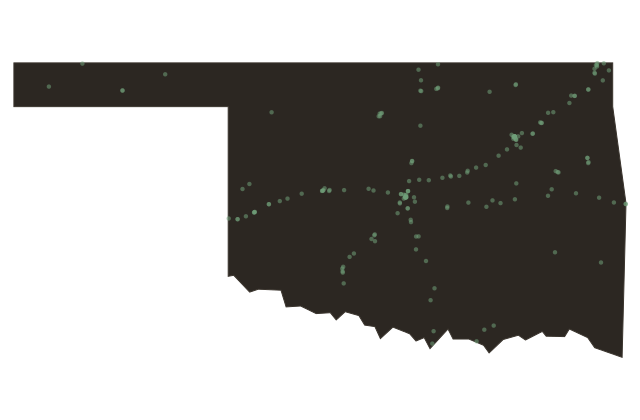
Three Nations, One Boundary, Osage, Cherokee, and Choctaw Territory
Near Fort Smith, Oklahoma
The geography of Indian Territory was not blank space on a map. It was a layered and contested legal landscape shaped by more than a dozen removal treaties, centuries of prior sovereignty, and the competing claims of nations that had been pushed into contact with each other by American expansion. The Osage, whose name for themselves is Wazhazhe, had lived along the Arkansas and Verdigris rivers for generations before Europeans arrived.
Their territory extended from present-day Missouri across what is now Kansas and Oklahoma, and they were formidable enough that French fur traders had courted rather than conquered them for more than a century. The removal era pushed them steadily westward, but their presence defined the northern tier of what would become Indian Territory. The Cherokee Nation occupied the northeastern corner of the Territory.
The Western Band had arrived in the seventeen nineties and early eighteen hundreds, pushed from Tennessee and Georgia by a combination of pressure and persuasion. After the main removal of eighteen thirty-eight and eighteen thirty-nine, the reunited Cherokee Nation built one of the most sophisticated governments in the Western Hemisphere: a two-house legislature, a bilingual newspaper, a supreme court, and a national school system, all centered at Tahlequah, well under one hundred miles west of Fort Smith. The Choctaw Nation held the southeastern quadrant, their boundary running roughly through the Kiamichi Mountains to the south.
The Choctaw had been among the first nations removed, arriving in the Territory through harrowing winter marches in the eighteen thirties. They, too, built an enduring government, with their capital at Tuskahoma. Fort Smith sat exactly at the seam where these jurisdictions pressed against the Arkansas state line and against each other.
It was the place where federal law nominally governed citizens of the United States and tribal law governed citizens of the nations. What filled the gap between those two systems was a long story involving gunfighters, outlaws, whiskey traders, and one very determined federal judge.