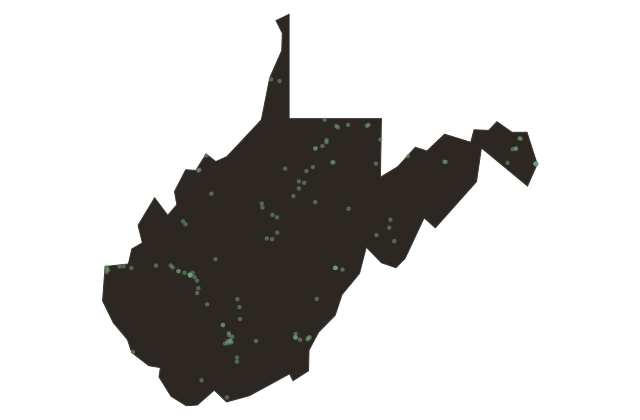
Sky Islands: The Red Spruce Forest Above Four Thousand Feet
Near Snowshoe, West Virginia
The high ridges of Cheat Mountain are what ecologists call sky islands, pockets of northern forest stranded on southern mountain summits, separated from the main boreal zone hundreds of miles to the north. Above roughly four thousand feet, the trees shift from the mixed hardwoods of lower West Virginia to red spruce and balsam fir, a forest that looks and smells more like Quebec than the mid-Atlantic. These summit forests shelter species found in few or no other places.
The Cheat Mountain salamander, a small dark amphibian that lives only at high elevations in a few mountains of eastern West Virginia, exists nowhere else on earth. The West Virginia flying squirrel, another species found only in this region's high spruce forests, glides between the trees on these ridges. And snowshoe hares, whose range extends south from Canada through the northern forests, reach their absolute southern limit in the East on this mountain.
The logging era that ended around nineteen sixty stripped most of the old-growth red spruce from these peaks, leaving the mountain bare. The recovery has been slow. Conservation organizations and government agencies have spent decades replanting red spruce across Cheat Mountain and the neighboring Back Allegheny, trying to rebuild forests that took centuries to grow.
Cheat Mountain still supports what experts call the most extensive red spruce forests south of the Adirondacks, a distinction earned partly by what survived and partly by what is slowly growing back.