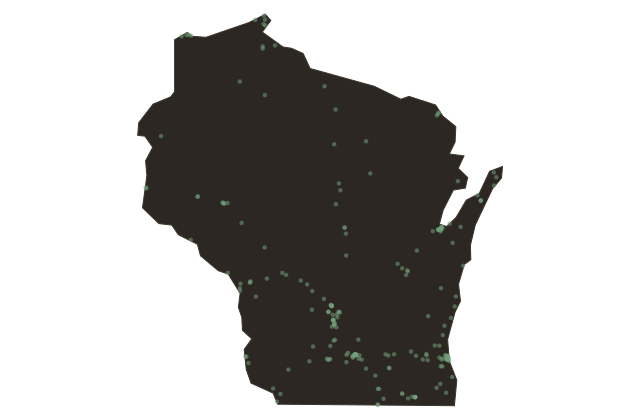
Mazomanie, Wisconsin
Wisconsin
The small village of Mazomanie, tucked into the valley of Black Earth Creek west of Madison, has an origin story that unfolds in two very distinct chapters, and those chapters explain almost everything about how the American Midwest was settled.
The first chapter began in eighteen forty-four, when more than nine hundred English immigrants arrived under the banner of the British Temperance Emigration Society. The Society had been founded in Liverpool in eighteen forty-two with a practical mission: select members by lot, give each family an eighty-acre farm in Dane County, Wisconsin, and build a community grounded in sobriety and self-sufficiency. What they did not account for was the market. These settlers, clerks, shoemakers, watchmakers, makers of nautical equipment, had no easy way to sell whatever grain they managed to coax from the unfamiliar Wisconsin soil. By the late eighteen forties they were producing modest surpluses and going nowhere with them. The emigration society stopped sending money, and the settlement stagnated.
The second chapter arrived in eighteen fifty-five, carried by the Milwaukee and Mississippi Railroad. When the line's superintendent, Edward Brodhead, chose the valley of Black Earth Creek as his route west from Madison toward the Wisconsin River, he saw the promise of the English settlement and platted a new commercial village. He named it Mazomanie, a word he believed meant Iron Horse in a Native language, an apt name for a railroad town, though the word actually honors a Ho-Chunk chief and means something closer to Iron Walker.
The railroad transformed everything. Within two decades, Mazomanie had grown into a commercial and industrial center of more than eleven hundred people. The struggling English farmers finally had a market for their wheat, and the downtown that Brodhead platted filled with merchants, mills, and taverns. The contrast between the temperance ideals of the founders and the saloon culture of a railroad boom town was not lost on anyone.
Today, Mazomanie's downtown historic district preserves the architecture of that railroad era, and the village remains an anchor of the Wisconsin Driftless region, a landscape that escaped the last ice age's grinding and kept its hills and hollows intact.