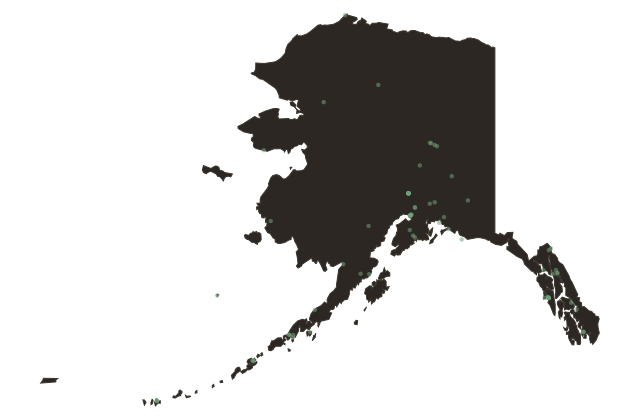
Tongass National Forest: The Largest National Forest in the United States
Alaska
The Tongass National Forest covers sixteen point seven million acres of Southeast Alaska, from the Alexander Archipelago in the south to the top of the Alaska Panhandle near Skagway. It is not simply the largest national forest in the United States. It is larger than the state of West Virginia. It contains more than five thousand glaciers. It holds roughly a third of the world's remaining old-growth temperate rainforest. It is, by area, one of the largest intact forest ecosystems on earth.
The Tlingit, Haida, and Tsimshian peoples have inhabited this landscape for at least ten thousand years. The Tlingit are divided into numerous clans and moieties organized around the Raven and Eagle. The Haida, whose most concentrated presence is on Prince of Wales Island, were famous for the largest oceangoing canoes on the Northwest Coast and for the totem poles whose remnants survive in collections around the world. The Tsimshian community at Metlakatla is the only Canadian First Nation that legally emigrated to the United States, establishing a reserve on Annette Island in eighteen eighty-seven.
These nations did not disappear. They live within and around the forest, hold subsistence rights to its fish and game, operate cultural centers and tribal governments, and have been in sustained legal and political conflict with the federal government over the management of a forest that sits on their ancestral homeland.
The Inside Passage, the protected waterway between the mainland and the archipelago that cruise ships navigate through, is the Tongass's most visible geography from outside. The fishing communities of Ketchikan, Wrangell, Petersburg, Sitka, Juneau, and Haines are all within or adjacent to the forest. Salmon is the economy and the culture.