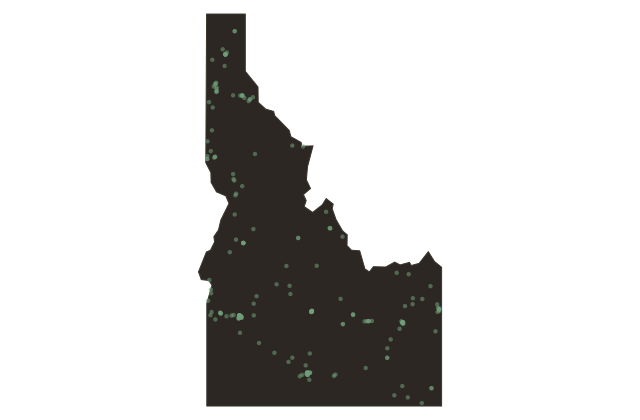
Shoshone-Bannock Homeland and the Snake River
Idaho
Long before a ferry crossed the Snake River here, this volcanic plain was the seasonal homeland of two distinct peoples: the Shoshone and the Bannock. The Northern Shoshone had roamed the Snake River Plain for thousands of years, following bison herds east into Wyoming and salmon runs west toward the Pacific. The Northern Paiute-speaking Bannock people moved into this region from the Great Basin and formed close ties with the Shoshone through intermarriage and shared hunting grounds. Together they knew the river not as a boundary but as a larder. The Snake, swollen with snowmelt from the Tetons and the Sawtooths, carried chinook salmon in enormous runs through this stretch of the high desert.
When Euro-American fur trappers arrived in the eighteen twenties, the Snake River Plain was already a well-mapped world. The North West Company and later the Hudson's Bay Company pushed through, and American mountain men followed. The trading post at Fort Hall, established in eighteen thirty-four to the southwest, became the first sustained American presence in the region, and its operators depended on Shoshone and Bannock goodwill to survive.
The crisis came with the overland emigrant tide. The Oregon, California, and Mormon trails all funneled through this corridor in the eighteen forties and fifties, destroying game, stripping the riparian grasses, and spreading disease. By the eighteen sixties the federal government had begun a systematic campaign to confine both peoples to reservations. The Fort Hall Reservation, set aside in eighteen sixty-seven and affirmed by the Fort Bridger Treaty of eighteen sixty-eight, lies just north of present-day Pocatello, where the Shoshone-Bannock Tribes still govern today. Their removal cleared the Snake River corridor for the railroad and the irrigation empire that followed, but they did not disappear. The tribal government at Fort Hall remains one of the most active in the American West, and the annual Shoshone-Bannock Festival has drawn visitors every August since nineteen fifty.