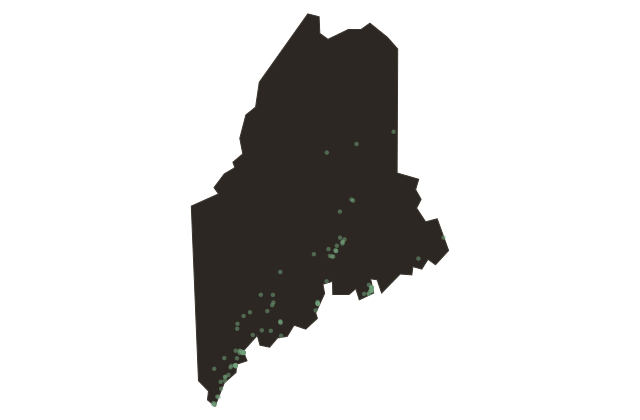
Gardiner, Maine
Maine
The small city of Gardiner, on the western bank of the Kennebec River, built its prosperity on ships, lumber, and ice, and gave American literature one of its quietest and most profound voices.
Dr. Sylvester Gardiner, a Boston physician and land speculator, acquired rights to this stretch of the Kennebec in the seventeen fifties and set about developing it, harnessing the energy of a dramatic waterfall where Cobbossee Stream meets the river to power sawmills, a potash factory, and a grist mill. By the early eighteen hundreds, Gardiner had become a serious river port. Shipbuilding drove the economy through the Civil War era, with ten large wharves lining the riverfront and wooden vessels leaving for domestic and foreign trade. Then came the ice industry. Beginning in the eighteen eighties, ice companies cut massive slabs from the Kennebec each winter and shipped them by schooner to cities as far away as the Caribbean and India. Gardiner became a city in eighteen forty-nine, near the height of its prosperity.
But Gardiner's most enduring gift to America is a poet. Edwin Arlington Robinson was born in Head Tide, Maine, in eighteen sixty-nine, and his family moved to Gardiner before his first birthday. He grew up on Lincoln Avenue, watching the town's characters, its strivers and failures, its dreamers and quiet tragedies. He renamed the place Tilbury Town in his poetry, and across twenty-eight volumes of work the people of Tilbury Town haunt his verse. Miniver Cheevy, who loved the days of old and scratched his head and kept on drinking. Richard Cory, the well-dressed man who went home one night and put a bullet through his head. Robinson won the Pulitzer Prize three times, in nineteen twenty-two, nineteen twenty-five, and nineteen twenty-eight, making him the most decorated American poet of his generation.
He is buried in a cemetery near the house where Tilbury Town was born.