Leech Lake and the Battle of Sugar Point
Minnesota
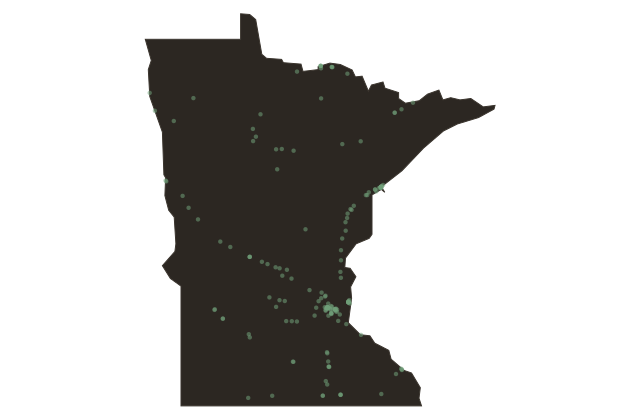
On October fifth, eighteen ninety-eight, a group of Ojibwe men on Sugar Point peninsula at the northwest shore of Leech Lake exchanged fire with a company of United States soldiers. Six soldiers were killed, ten wounded. At least seven Ojibwe were killed, including a tribal policeman shot by mistake, and nineteen more were wounded. It was the last armed conflict between the United States Army and Indigenous peoples in the territory of the contiguous states.
The fight grew from a specific grievance that had a specific individual at its center. Bugonaygeshig, also known as Hole-in-the-Day, was an Ojibwe man who had been arrested on a bootlegging charge and transported to the federal court in Duluth repeatedly against his will. When federal marshals came to Leech Lake to arrest him again, a group of men gathered at Sugar Point, and when the soldiers who accompanied the marshals moved to take the camp, shots were fired. The Army sent six companies of infantry and four Gatling guns to the lakeshore. The Ojibwe, with bolt-action rifles, inflicted roughly as many casualties as they suffered, despite being badly outnumbered and outgunned.
The Battle of Sugar Point is not often taught in American history courses. It does not fit the standard narrative arc of American western expansion, which typically ends the Indian Wars at Wounded Knee in eighteen ninety. Wounded Knee was December of eighteen ninety. Sugar Point was October of eighteen ninety-eight, in Minnesota, eight years later. The armed resistance was not over.
The Leech Lake Band has maintained its presence on the lake and in the national forest since. The reservation boundary runs through the forest. Sugar Point is on Leech Lake today, a wooded peninsula most people pass without knowing what happened there.