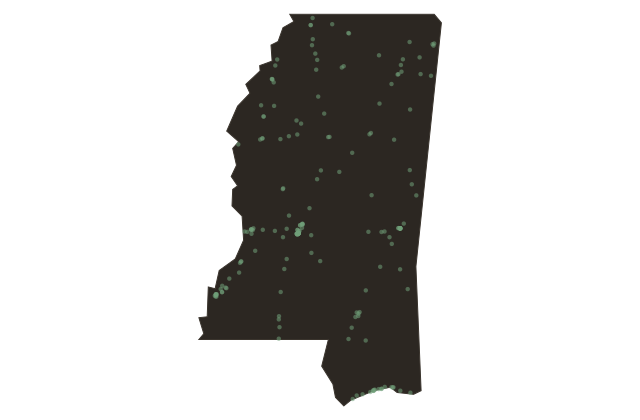
Waterways Experiment Station — Born from a Flood
Mississippi
The sprawling six-hundred-seventy-three-acre complex near Vicksburg that looks like a small city unto itself was born from catastrophe. In the spring of nineteen twenty-seven, the Mississippi River burst through its levees along a seven-hundred-mile front, flooding sixteen million acres, destroying more than nine thousand homes, and killing hundreds of people. It was the most destructive river flood in American history, and it proved, beyond any argument, that the nation did not understand the river it was trying to control.
Congress responded by authorizing the Mississippi River and Tributaries Project, the most ambitious flood-control undertaking ever attempted. And to design the vast system of levees, floodways, and spillways that project required, engineers needed something that had never existed before: a place to model the river scientifically.
In nineteen twenty-nine the Army Corps of Engineers established a small hydraulics laboratory in Vicksburg, the city that already served as headquarters of the Mississippi River Commission. Land was purchased near Durden Creek in February of nineteen thirty, and the Waterways Experiment Station opened for business. It was the first federal hydraulics research facility in American history.
What the scientists built here was, in a sense, a miniature Mississippi. Scale models of river reaches, harbor approaches, and flood channels allowed engineers to test interventions before committing to them in concrete and earthwork. Decisions that once depended on intuition and experience could now be modeled, measured, and revised. The Bonnet Carré Spillway upstream from New Orleans, the great emergency valve that protects the city, was designed with data produced at Vicksburg.
The station eventually grew into the Engineer Research and Development Center, the Corps' largest engineering and scientific research facility in the world. The original nineteen thirties cantonment is listed on the National Register of Historic Places, a monument to the moment when American engineering stopped guessing about the Mississippi and started listening to it.