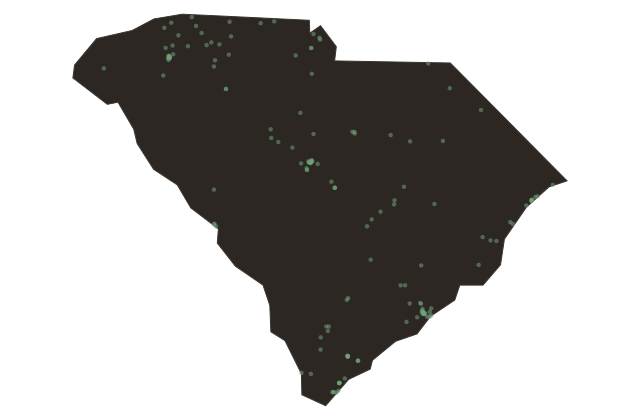
Greenville, South Carolina
Near Greenville, South Carolina
Greenville spent most of the twentieth century calling itself the Textile Capital of the World, and for several decades the claim was defensible. The Reedy River had powered the first mill here as early as seventeen seventy-seven, but the real explosion came in the eighteen seventies when Piedmont Manufacturing and the Camperdown Mills opened on its banks. With new rail connections and an influx of northern capital in the eighteen nineties, Greenville caught what contemporaries called mill fever. Factories and their attached mill villages multiplied rapidly across the county.
By the nineteen twenties Greenville County had more cotton spindles than anywhere else in South Carolina. By the nineteen thirties nearly twenty major mills lay within three miles of downtown, one of which was said to be the largest cotton mill under a single roof in the world. The Southern Textile Exposition, held at Greenville's Textile Hall, drew international buyers and exhibitors for decades. In nineteen forty-six the city could advertise itself without embarrassment.
But mill fever carries its own costs. Mill workers lived in company-owned housing, shopped at company stores, and worshipped in company-funded churches. The villages were paternalistic and insular. And the textile industry was nearly entirely white by design , Black workers were systematically excluded from mill jobs throughout the Jim Crow era.
Globalization and mechanization began hollowing out the mills in the mid-twentieth century, and by the nineteen eighties the collapse was severe. The civic response was to reinvent the city around its waterway. The Camperdown Bridge , a six-lane highway that had buried the Reedy River falls under concrete , was controversially removed in two thousand two. Falls Park opened in two thousand four on the reclaimed riverbank, and the transformation became one of the most cited examples of urban renewal in the South.
Today Greenville is one of the fastest-growing cities in the Carolinas , drawn not by spindles but by advanced manufacturing, healthcare, and a downtown that people actually want to walk through. The mills that survive have been converted to apartments, offices, and breweries.