The Fireflies That Learned to Flash Together
Near Columbia, South Carolina
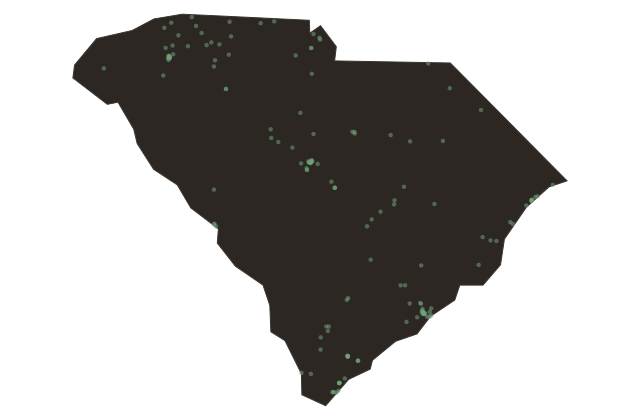
For a few weeks each May and June, after dark in the Congaree floodplain forest, the fireflies flash in synchrony.
Most firefly species flash at random, each individual communicating its own signal on its own schedule. The synchronous fireflies of Congaree, a species called Photuris frontalis, have evolved differently. The males begin flashing in clusters that spread across the understory in waves, eventually synchronizing across hundreds or thousands of insects at once. The forest goes from scattered random light to pulsing coordinated light across a territory of several acres. The mechanism is not fully understood. The synchronization appears to involve a form of entrainment, each firefly responding to and influencing the flashes of its neighbors until the whole group locks into a shared rhythm.
Congaree is one of only a handful of sites in the United States where synchronous firefly displays have been documented, and it is one of the few places in the country where the phenomenon occurs reliably enough to attract visitors specifically for the display. The Elkmont area of Great Smoky Mountains National Park is the better-known synchronous firefly site, but Congaree's bottomland forest produces its own display in a setting that is darker and wilder than most easily accessible forest in the East.
The display requires a good night. It requires that it not rain. It requires that you stand still long enough for your eyes to adjust. When the conditions are right, the forest below you does something that has no obvious parallel in the ordinary world, and then the fireflies quiet down, and the dark is just the dark again.