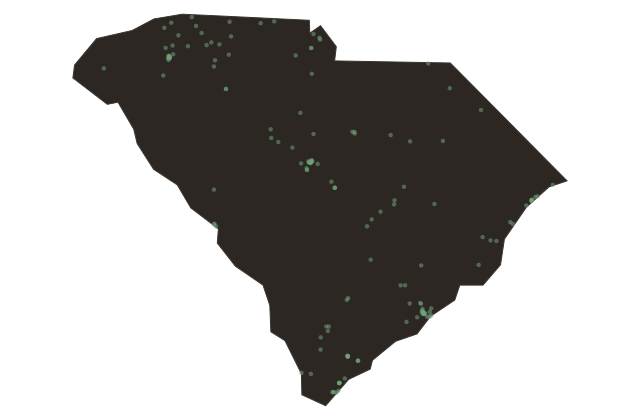
The World's First Electric Textile Mill
Near Columbia, South Carolina
On April fifteenth, eighteen ninety-four, the president of the Columbia Mills Company pulled a switch. The motors hummed. The spindles began to turn. And in that moment, the building at three oh one Gervais Street became the first textile mill anywhere in the world to run entirely on electricity.
This was not a small thing. Textile mills in the eighteen nineties were typically powered by steam engines or direct water wheels, with dangerous belts and shafts running throughout the building. Lint-filled air and sparking machinery caused regular catastrophic fires. A General Electric salesman named Sidney Paine had proposed something different: use the Columbia Canal, which ran nearby, to power two one-thousand-horsepower water turbines. Those turbines would generate alternating current electricity. The electricity would run to induction motors mounted throughout the mill, motors with no sparks, constant speed, and far less fire risk.
The Columbia Canal had been built in eighteen twenty-four to allow cotton boats to bypass the falls of the Congaree River. In eighteen eighty-eight, the State of South Carolina decided to enlarge it specifically to generate industrial electricity for the city. The enlarged canal opened in eighteen ninety-one. Columbia Mills Company was the first to use it in this way.
By nineteen oh seven, the mill was running more than thirty thousand spindles and employed twelve hundred workers. It specialized in duck cloth, the heavy durable fabric used for sails, tents, awnings, and belting.
The mill closed decades later and the building was carefully preserved. Today it houses the South Carolina State Museum, which opened in October of nineteen eighty-eight. The turbine room and powerhouse infrastructure are still visible within the building. You are standing at the site of an industrial first that happened to also be in the middle of a state capital.