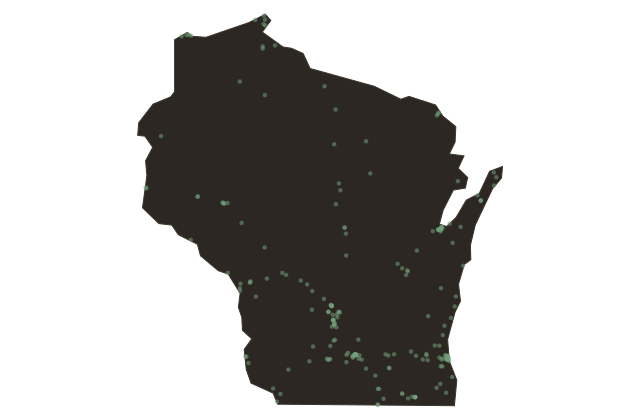
Tee Wakącąk: The Sacred Lake
Near Baraboo, Wisconsin
The Ho-Chunk people have a name for this lake that the early European settlers did not bother to learn. They called it Tee Wakącąk, the Sacred Lake. It is not hard to understand why. The lake sits inside a gorge flanked by five-hundred-foot bluffs of ancient quartzite, the rock a deep reddish-pink, the cliffs plunging to still dark water that has no visible inlet or outlet. The effect is of a world set apart, and Indigenous people recognized that quality for thousands of years before anyone else arrived.
The bluffs are part of the Baraboo Hills, a range formed one point six billion years ago from what was once a massive mountain chain. Those ancient peaks eroded down to quartzite, which is among the hardest of all rocks, and so the Baraboo Hills outlasted everything around them. The gorge that holds the lake was carved by an ancient river. When the last glacier advanced over Wisconsin approximately fourteen thousand years ago, debris from the melting ice plugged both ends of the gorge, cutting off the original river and trapping water in the bowl. That is the lake: a glacial accident in a billion-year-old canyon.
Evidence suggests people have sheltered in this area for close to ten thousand years. Mound-building cultures arrived roughly a thousand years ago and left effigy mounds on both the north and south shores. Ho-Chunk oral tradition describes the lake as the home of a water spirit of great power dwelling at the center of the earth.
The first recorded European visitor, John T. de La Ronde, arrived in eighteen thirty-two. Wisconsin established a state park here in nineteen eleven, the third in the state and now the largest and most visited. Through the nineteen thirties the Civilian Conservation Corps built the quartzite-staircase trails that still climb the bluffs, using stone quarried directly from the park.
The name the settlers gave it, Devil's Lake, inverted the meaning the Ho-Chunk intended. The official name has not changed. But the Ho-Chunk name, and its meaning, was there first.