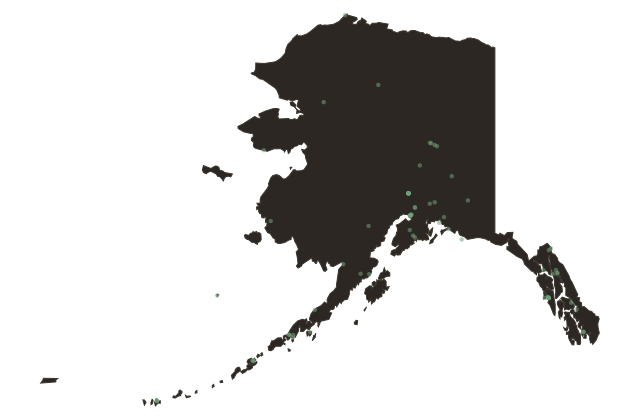
The Seven Nations: Alaska Native Is Not One Thing
Alaska
Alaska has roughly two hundred twenty-eight federally recognized tribes. They do not share a language, a culture, a governance structure, or a geography. They represent seven major cultural-linguistic traditions, and those traditions are as distinct from each other as the Norse are from the Berber.
The Tlingit and Haida of Southeast Alaska are maritime nations of totem poles, potlatches, and ocean-going canoes. Their art tradition is among the most formally sophisticated in the world. The Tsimshian, originally from what is now British Columbia, established Metlakatla on Annette Island in eighteen eighty-seven, the only Alaska Native reserve. The Central Council of Tlingit and Haida Indian Tribes of Alaska represents more than forty-two thousand members today.
The Athabascan peoples of the Interior comprise eleven distinct nations, each with its own language and territory across the vast drainage basins of the Yukon and Kuskokwim Rivers. The Gwich'in, whose territory straddles the Alaska-Yukon border, have been among the most vocal opponents of oil development in the Arctic National Wildlife Refuge, which overlaps the calving grounds of the Porcupine caribou herd.
The Yupik of Western Alaska are the most populous of Alaska's Indigenous cultural groups, approximately twenty-one thousand people spread across roughly sixty villages in the Yukon-Kuskokwim Delta. Most have no road access to the state highway system.
The Inupiat of the North Slope are the Arctic peoples whose subsistence economies center on marine mammals and the bowhead whale. The Aleut, who call themselves Unangan, have inhabited the Aleutian Archipelago for at least nine thousand years.
Each of these nations came into contact with Russia, with the United States, and with the twentieth century on its own terms and in its own sequence. None of them is interchangeable with any of the others. The phrase Alaska Native encompasses all of them, and explains almost nothing about any one.