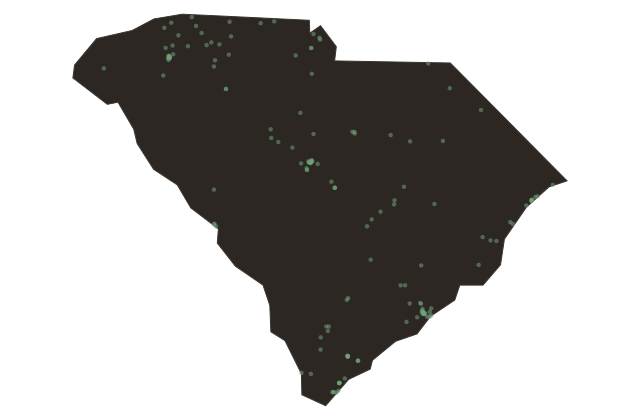
Charleston Naval Shipyard
South Carolina
Along the west bank of the Cooper River in North Charleston stands what was, for nearly a century, one of the most strategically important naval installations on the Atlantic Coast.
The Charleston Naval Shipyard opened in nineteen oh one as a drydock facility, initially modest in scale. Its first major test came in World War One, when the yard overhauled and outfitted dozens of vessels for transatlantic service. But the Second World War transformed it completely. Between nineteen forty-one and nineteen forty-five, the shipyard employed as many as twenty-six thousand workers, including thousands of women and African American civilians entering industrial labor at a scale Charleston had never seen. During those years, the yard built more than two hundred vessels, among them twenty destroyers that fought in combat and one hundred twenty-one landing ship mediums, the flat-bottomed craft that delivered troops and tanks onto beaches from Normandy to the Pacific.
After the war, the Navy designated Charleston as a primary submarine overhaul center. The first boat arrived for refit in nineteen forty-eight, and through the nineteen fifties and sixties the yard moved fully into the nuclear age. Workers converted and serviced Polaris ballistic missile submarines, vessels that carried America's undersea nuclear deterrent during the Cold War. The first drydocking of a fleet ballistic missile submarine, the USS Thomas A. Edison, happened here in nineteen sixty-six.
At its Cold War peak, the broader Charleston Naval Complex employed more than thirty-five thousand military and civilian workers, making it the single largest employer in South Carolina. Its closure was sudden and devastating. In nineteen ninety-three, the Base Realignment and Closure Commission recommended shutting down the complex. On April first, nineteen ninety-six, operations ceased, eliminating nearly fifteen thousand jobs in a single day. The economic shock rippled across the region for a decade.
The old yard did not stay idle long. Detyens Shipyards eventually leased the drydocks and piers, making it the largest commercial ship repair facility on the East Coast. And portions of the former base have been redeveloped as a mixed-use innovation district. But the scale of what was lost, the workforce, the identity, the sheer industrial weight of the place, remains part of how North Charleston understands itself.